
The 60-Day Ghost Problem: Why Your Best Customers Disappear Without a Word
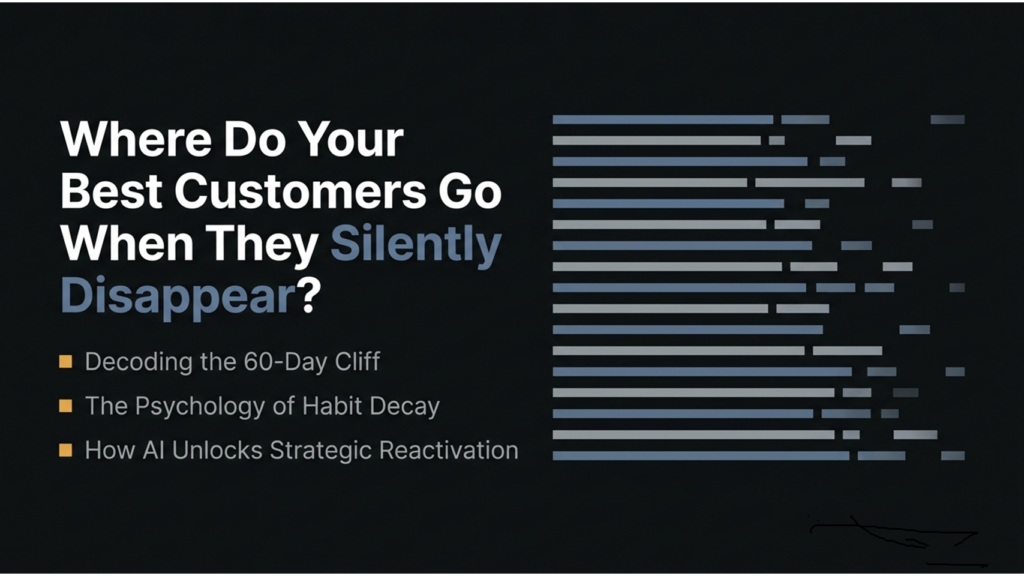 Every restaurant owner knows the feeling. You are wiping down the bar at 8 PM on a Tuesday, staring at three empty tables that used to belong to regulars. Maybe it is the couple who came every Friday for date night. Maybe it is the solo diner who always ordered the risotto and tipped 25%. They did not leave a bad review. They did not complain. They simply vanished.
Here is the uncomfortable truth. Most restaurants do not die from bad food or terrible service. They die from forgetting. A customer drifts away, and nobody notices until the drift becomes permanent. By the time you realize they are gone, they have already found a new spot, built a new routine, and mentally deleted your address from their phone.
The data backs this up. In the restaurant industry, a customer who has not visited in 60 days is already 70% likely to never return. That is not a theory. That is behavioral decay in action. Out of sight, out of mind, out of habit. The window to save them is narrow, and the old tools are embarrassingly blunt.
Email blasts get buried. SMS feels impersonal and easy to ignore. Social media ads are just noise. What actually cuts through? A voice. A real conversation. Not a robocall from 2003, but an intelligent, context-aware phone interaction that feels like your best host just personally reached out because they genuinely missed someone.
That is where the new wave of AI Phone Agent workflows changes everything. Not as a gimmick. As a full operational system that turns your dormant member list into a revenue recovery engine.
Why 60 Days Is the Magic Number
Sixty days is not arbitrary. It is just past the edge of a habit loop. Psychologists call this the “extinction point.” For dining habits, two months without a visit means the neural pathway that used to lead to your door has started to erode. The customer is not angry. They are not even disappointed. They are simply neutral. And in the restaurant business, neutrality is death.
But here is the flip side. Extinction is not irreversible yet. At 60 days, the customer still remembers you fondly. They still have taste memories. The emotional residue is positive, it is just cooling. This is the exact moment where a well-timed, psychologically intelligent intervention can reignite the pattern.
The goal is not to offer a generic discount. That trains customers to wait for coupons. The goal is to create a moment of personal recognition. To make the customer feel seen, remembered, and slightly guilty for abandoning a place that clearly values them. That is an emotional trigger, not a financial one.
The Anatomy of a Smart Recovery Call
Let us walk through a real scenario. Imagine a bistro called Hendricks. They use a standard POS system like Toast or Square, connected to a lightweight CRM in Airtable. Every member’s visit history, favorite orders, and last seating preference is logged automatically.
On day 61 of inactivity, the system flags a customer named David. He used to come every other Wednesday for the chef’s burger and a local IPA. He always sat at the bar. He has not been in for 73 days.
The AI Phone Agent initiates a call at 6:15 PM, a time when David is likely commuting home and receptive to a short conversation. Not during dinner rush. Not during his morning commute. Timing is a variable, not a constant.
“Hey David, this is Hendricks. I know, I know, it has been a minute. We were looking at the books and realized we have not seen you in a few weeks. The bartender actually asked about you last night. We are running a small thing for the regulars we have missed, just for the next 48 hours. A personal code for 20% off, and I can text it to you right now. No pressure, but the new summer menu is hitting next week and I think you would lose your mind over the smoked brisket burger.”
Let us break down what just happened, because this is not a script. It is a behavioral architecture.
First, the agent used specificity. “The bartender asked about you.” That is social proof layered with personal recognition. It implies David is a known entity, not a number. Then there is scarcity with a deadline. “Next 48 hours.” That triggers loss aversion. Then there is curiosity. “The smoked brisket burger.” Not “new items.” Something specific that connects to his known preference.
The agent does not read a menu. It makes a judgment call based on his order history, pulled directly from the CRM and POS records that the system already maintains. The system knows his average spend, his tipping behavior, his dietary patterns. It filters out offers that do not match his profile. If David is a burger guy, offering him the new vegan tasting menu is insulting. The AI knows better because it is reading the same data your hostess would remember.
What Happens Under the Hood
The workflow is where the magic hides. It is not just a phone call. It is an orchestrated business system.
The trigger originates in the POS or CRM. A simple query runs nightly. Anyone with a membership ID who has not logged a transaction in 60 days gets pushed into a reactivation queue. The system already holds the enriched data. It pulls the customer’s last three orders, calculates their average ticket size, checks if they have ever booked a private event, and scans for any recent negative feedback or refund history. It can even check local weather data through a connected API. If there is a thunderstorm forecast for the next two days, the agent might pivot to a cozy indoor experience rather than patio seating.
The call itself is handled through Twilio or a similar voice API, but the intelligence layer is the AI Agent. It does not just speak. It listens. It detects sentiment. If David sounds annoyed, the agent shifts to a shorter, more apologetic tone and offers to remove him from outreach. If he sounds curious, the agent extends the conversation, asks about his work schedule, and suggests a specific reservation time. If he mentions he moved to a different neighborhood, the agent logs that as churn intelligence and offers him the private catering menu instead.
During the call, the agent can perform live actions. If David says yes to the offer, the agent generates a unique, single-use discount code in Shopify or WooCommerce, texts it to him via Twilio SMS, and drops a note into a Slack channel for the general manager. “David M. reactivated. Code BURGER20 sent. Predicted visit: Wednesday. Mention the brisket.”
If David says he is busy, the agent does not hang up and forget him. It schedules a follow-up call in 14 days, updates his CRM tag to “soft churn, work conflict,” and triggers a gentle email sequence through Gmail or SendGrid with behind-the-scenes kitchen content to keep the brand warm.
If David says he had a bad experience last time, the agent does not argue. It apologizes, offers a comp appetizer, and immediately creates a task in the manager’s calendar for a personal callback. That is not automation replacing humans. That is automation elevating the right moments to human attention.
And here is the critical part. Once the call ends, the system processes the conversation data according to your business logic. It can analyze the transcript, extract sentiment, update customer records, and trigger downstream actions without anyone touching a spreadsheet. If David mentioned he is gluten-free now, that tag gets added. If he complained about the noise level, that gets flagged for the ops team. The workflow does not end when the line goes dead. That is when the real intelligence work begins.
The Intelligence Layer Nobody Talks About
Most people think AI phone calls are about saving labor. They are wrong. The real value is intelligence gathering.
When you have a hundred of these conversations happening weekly, patterns emerge. You start hearing, again and again, that customers stopped coming because parking got impossible after the new construction started. Or because your online menu still shows the old winter dishes and they thought you never updated. Or because a competitor opened two blocks away with a similar vibe but cheaper wine.
That is gold. That is actionable business intelligence that no survey form or Yelp review will ever capture honestly. People lie in writing. They tell the truth in conversation, especially when they think they are talking to a person who actually cares.
The AI logs these objections, clusters them by frequency, and pushes a weekly summary to the owner. “This week, 12 dormant members mentioned the new parking situation. 7 said they thought you closed early now. 3 complained about the playlist being too loud.” Suddenly, your phone system is not a cost center. It is a market research department that pays for itself. And all of that insight gets processed and structured after the calls complete, feeding directly into your decision-making workflow.
The Psychology of the Exclusive Return
There is a subtle art to the offer itself. The discount cannot feel like a mass coupon. It has to feel like a secret. Behavioral economists call this the “endowment effect.” When someone feels they have been given something exclusive, something not available to the general public, they value it more. Even if the dollar amount is identical to a public Groupon.
The AI Agent leans into this by framing. It does not say, “We are offering 20% off to everyone.” It says, “This is a small list we made of people we genuinely miss. The code dies in 48 hours, and it is only good for you.” That is reciprocity in action. The restaurant is giving David something personal. He feels a micro-obligation to reciprocate with a visit.
The time limit is critical. Not 30 days. Not a week. 48 hours. Short enough to force a decision. Long enough to allow planning. Urgency without panic.
And the follow-up matters. If David uses the code, the system tags him as “reactivated” and moves him into a VIP nurture track. If he does not use it within 36 hours, he gets a single SMS reminder. “Hey David, your Hendricks code expires tonight. The brisket burger is waiting.” That is it. No harassment. No drip campaign from hell. Just one nudge.
From Recovery to Revenue
Let us talk numbers, because strategy without economics is just daydreaming.
Acquiring a new restaurant customer costs between $40 and $80 in most urban markets, depending on your marketing mix. Reactivating a dormant member costs roughly $1.20 in AI call time plus the margin hit on a 20% discount. If David’s average ticket is $65 and he visits twice a month, his annual value is $1,560. Spending $13 to save $1,560 is not a good deal. It is an obscene deal.
But the math gets better. Reactivated members have higher lifetime value than new customers. They already trust you. They already know the menu. The friction is zero. A reactivated regular is worth roughly 1.4x a brand new customer because their second, third, and fourth visits happen faster.
Scale this. If you have 400 dormant members and your AI workflow recovers just 12% of them monthly, that is 48 extra covers per month. At $55 average ticket, that is $2,640 in monthly revenue from people who were already written off. Over a year, with repeat visits, you are looking at six figures of recovered lifetime value. From a system that runs while you sleep.
The Bigger Picture: Restaurants as Member Clubs
This is where we need to zoom out. The future of independent restaurants is not about tables and chairs. It is about membership. The most resilient restaurants are treating their customer base like a private club. They know who you are, what you like, when you last visited, and what might bring you back. They are not waiting for you to remember them. They are actively managing the relationship.
AI Phone Agents are the missing layer in that vision. They provide the intimacy of a maître d’ who remembers every guest, but at the scale of a hundred locations. They turn the passive database into an active retention engine.
The old model was reactive. A customer stops coming, you eventually notice the empty seat, maybe you run a Facebook ad to strangers. The new model is predictive. The system knows the 60-day cliff is approaching. It intervenes at the exact psychological moment with the exact right message. It learns from every conversation. It gets smarter.
And for the customer? It feels like being noticed. In a world of infinite digital noise, a phone call from a place you actually liked is almost shocking. It is human. It is warm. It is the opposite of the anonymous internet.
Getting Started Without the Overwhelm
You do not need to rebuild your entire tech stack. Most restaurants already have the pieces. A POS system with customer history. A simple CRM or even a Google Sheet. A calendar. An email account. The AI Phone Agent workflow sits on top of these via API connections, pulling data, making decisions, and pushing actions back.
Start with one segment. Just the 60-to-90-day dormants. Build one call script that feels like your best host talking. Test it with ten customers. Listen to the recordings. Adjust the tone. Tighten the offer window. Then let it run.
Within a month, you will know exactly why people left. You will know exactly what brings them back. And you will stop staring at empty tables, wondering where everybody went.
They are still out there. They just need the right voice to remind them why they loved you in the first place.